Chapter 1: The Vitals of Data#
Understanding Study Design and Levels of Measurement#
Unit: 1 | Part: I — Describing the World in Numbers
Datasets:
Framingham Heart Study teaching subset (
framingham_teaching.csv, n = 500) — ObservationalAnorexia Clinical Trial (
anorexiaviaMASSpackage, n = 72) — Experimental
Learning Objectives
By the end of this chapter, you will be able to:
Differentiate between observational and experimental study designs.
Distinguish between categorical and continuous data.
Identify the four levels of measurement: nominal, ordinal, interval, and ratio.
Classify every variable in our datasets at the correct level.
Load the datasets in PSPP and R and inspect their structure.
Why This Chapter Comes First#
Before calculating a single mean or p-value, you must answer two fundamental questions: How was this data collected? and What kind of data do I actually have?
This is not just housekeeping. It determines every statistical test you can legitimately run. Apply the wrong test to the wrong data type and the software will still confidently produce a number — it will simply be mathematically meaningless.
Observational vs. Experimental Design#
In public health, data generally comes from one of two study designs, both of which we will use throughout this book:
1. Observational Epidemiology (The Framingham Heart Study)
The Method: Researchers observe participants over time without intervening. They measure baseline variables (like blood pressure or smoking habits) and wait to see who develops disease.
The Goal: To identify risk factors and understand how a disease develops naturally.
The Limitation: We can find strong associations, but proving direct cause-and-effect is difficult because researchers do not control the environment.
2. Experimental Epidemiology (The Anorexia Clinical Trial)
The Method: Researchers actively intervene. Patients are assigned to different groups (e.g., standard care, Cognitive Behavioral Therapy, Family Therapy).
The Goal: To test the effectiveness of a specific treatment or cure.
The Strength: Because researchers control the intervention, this design provides the strongest evidence for cause-and-effect.
Whether you are watching a disease progress or testing a psychological therapy, the next step is looking at the actual measurements. A systolic blood pressure of 0 mmHg means cardiac arrest. An education level of 0 means something entirely different. Getting that distinction right is where all analysis begins.
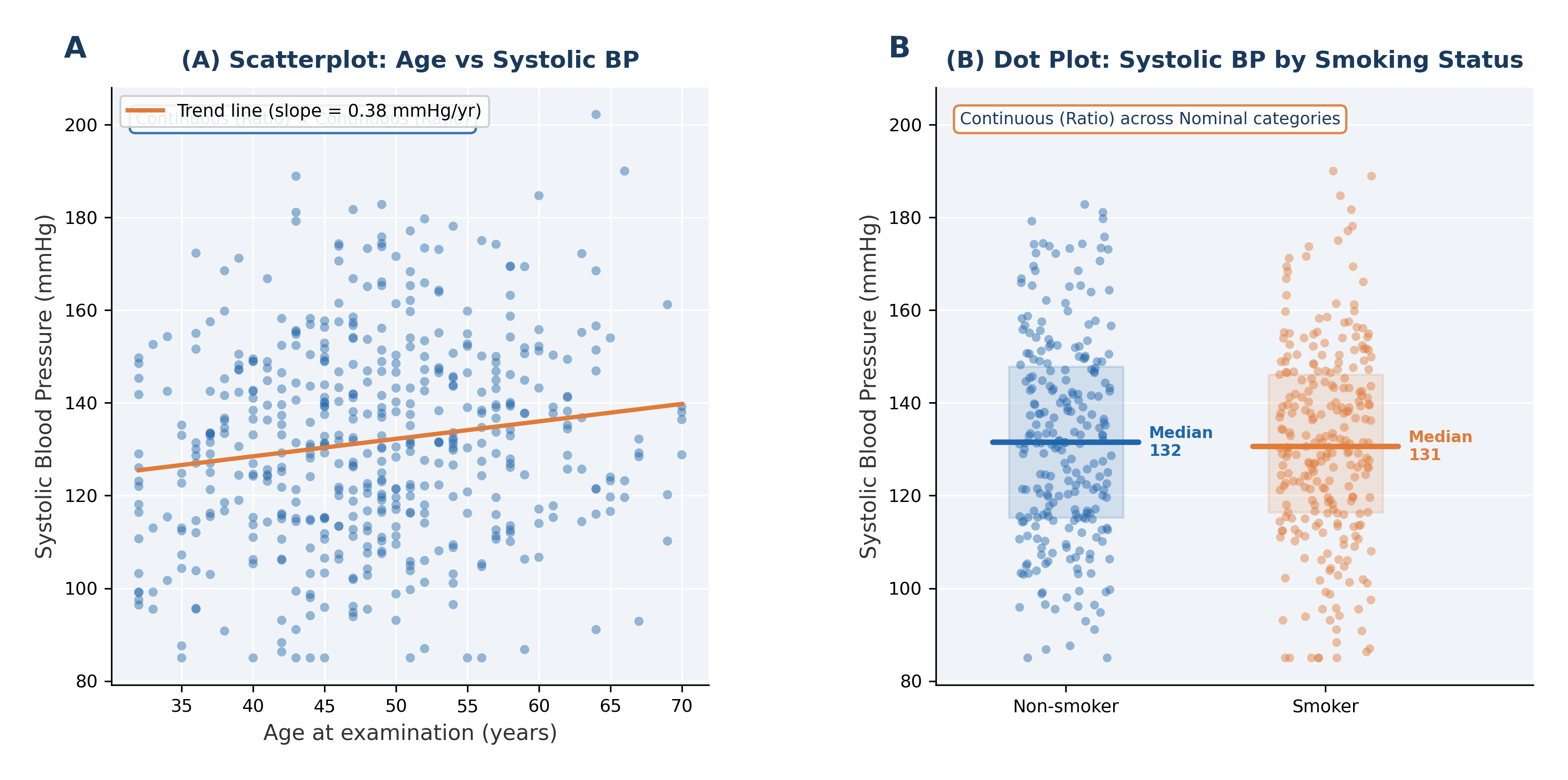
Fig. 1 Figure 1.1 Visualising Relationships and Distributions in the Framingham Study. These two graphs illustrate foundational concepts in Chapter 1. (A) Scatterplot of Systolic Blood Pressure vs. Age reveals a pattern in two continuous (Ratio) variables, suggesting as Age increases, BP tends to rise. (B) A grouped dot plot contrasts the distribution of Systolic BP (Ratio variable) across two Nominal categories: non-smokers and smokers.#
Section 1: The Two Families of Data#
All health data belongs to one of two broad families: categorical or continuous.
1.1 Categorical Data#
Categorical data places each observation into a named group. The values do not represent measurable quantities — doing arithmetic on them is meaningless.
Key diagnostic question: Can I calculate a meaningful average of this variable? If no \(\rightarrow\) categorical.
Examples:
SEX(Framingham) — 1 = Male, 2 = Female. The average of 1 and 2 is 1.5, representing no actual person.Treat(Anorexia) — CBT, FT, or Cont (Control). Three distinct therapy groups.CURSMOKE(Framingham) — 0 = non-smoker, 1 = current smoker. Two categories, not quantities.ANYCHD(Framingham) — did a coronary heart disease event occur during follow-up? 0 = No, 1 = Yes.DIABETES(Framingham) — 0 = no diabetes, 1 = diabetes present.
⚡ Common mistake: Storing a category as a number does not make it numeric.
SEX = 2does not mean “two units of femaleness”. Always convert categorical variables to factors in R before running an analysis.
1.2 Nominal Data#
💡 Plain English first: Nominal data is just names for groups — no ranking, no scale, no arithmetic. The only sensible statistical question is “which group appears most?”
Nominal data has categories with absolutely no natural order or ranking.
Property |
Nominal Data |
|---|---|
Categories exist |
✓ Yes |
Natural rank or order |
✗ No |
Measurable distances |
✗ No |
True zero |
✗ No |
Examples: SEX, CURSMOKE, DIABETES, BPMEDS, ANYCHD, DEATH, STROKE (Framingham); Treat (Anorexia).
A common error to avoid:
ANYCHDis mathematically coded as 0 and 1. A student who calculates the mean ANYCHD and reports “0.31” as a statistic is not mathematically wrong — this is a proportion (31% had a CHD event). But interpreting 0.31 as an “average CHD level” would be meaningless. The mean of a binary 0/1 variable gives you a proportion, not a numerical average.
1.3 Ordinal Data#
Ordinal data has categories that do have a natural rank order, but the distances between those ranks are not equal.
Property |
Ordinal Data |
|---|---|
Categories exist |
✓ Yes |
Natural rank order |
✓ Yes |
Equal distances between ranks |
✗ No |
True zero |
✗ No |
Framingham example:
EDUC— education level: 1 = 0–11 years, 2 = High school/GED, 3 = Some college, 4 = College graduate or higher.
The rank order is meaningful — Level 4 represents more education than Level 1. But the gap between Level 1 and Level 2 (completing high school) is not the same magnitude as the gap between Level 3 and Level 4 (completing a college degree). We cannot mathematically say a Level 4 person has “twice the education” of a Level 2 person.
Other clinical examples:
Cancer staging: Stage I, II, III, IV — ranked, but not equally spaced.
Pain severity: Mild, Moderate, Severe — ranked, gaps unequal.
Glasgow Coma Scale (3–15) — ranked scores, but the clinical meaning of each 1-point increment differs wildly.
The critical insight: With ordinal data, you know the direction of a difference between two patients, but you do not know the exact size of that difference.
1.4 Continuous Data#
Continuous data records a genuine numerical measurement where arithmetic operations produce meaningful, real-world results.
Key diagnostic question: Does this number represent a real measurement where the gaps between values are equal and meaningful? If yes \(\rightarrow\) continuous.
Examples:
SYSBP(Framingham) — systolic blood pressure in mmHg. 140 mmHg is genuinely higher than 120 mmHg by exactly 20 mmHg.TOTCHOL(Framingham) — total cholesterol in mg/dL.Prewt/Postwt(Anorexia) — body weight in pounds.AGE(Framingham) — age in years at examination.BMI(Framingham) — body mass index in kg/m².
1.5 Interval Data#
Interval data has equal, meaningful distances between values, but no true zero point. A value of zero does not mean the complete absence of the quantity.
Property |
Interval Data |
|---|---|
Equal distances |
✓ Yes |
True zero |
✗ No |
Ratios meaningful |
✗ No |
Examples:
Temperature in °C: 0 °C is not “no temperature” — it is just an arbitrary freezing point. 40 °C is not twice as hot as 20 °C.
Calendar year: Year 0 does not mean “no time”. You cannot say 2024 is “twice as recent” as 1012.
Standardised test scores: A score of 0 does not mean zero knowledge.
In the Framingham dataset, the year of birth (which we could calculate from age and the study start year) is interval — there are equal annual gaps, but no true “year zero”.
1.6 Ratio Data#
Ratio data has equal gaps and a true zero—a zero that genuinely means the complete absence of the thing being measured.
Property |
Ratio Data |
|---|---|
Equal distances |
✓ Yes |
True zero |
✓ Yes |
Ratios meaningful |
✓ Yes |
⚡ Common mistake: To tell interval and ratio apart, ask: does zero mean complete absence? Temperature 0 °C \(\neq\) no temperature (Interval). Blood pressure 0 mmHg = cardiac arrest, absolutely no measurable pressure (Ratio). Age 0 = newborn (Ratio).
Examples:
SYSBP: 0 mmHg = no measurable blood pressure. 160 mmHg is exactly twice 80 mmHg. ✓ Ratio.AGE: 0 years = newborn. Age 60 is twice as long a life as age 30. ✓ Ratio.BMI: 0 kg/m² = no body mass. A BMI of 30 is exactly \(1.5 \times\) the mass of 20. ✓ Ratio.CIGPDAY: 0 cigarettes = does not smoke at all. ✓ Ratio.Prewt: 0 lbs = no body weight. ✓ Ratio.
Why this matters clinically: Systolic blood pressure is ratio data. Saying “this patient’s BP is twice the normal value” is a legitimate and clinically actionable ratio statement. The value 0 mmHg is medically unambiguous. Treating BP as interval data would make such ratio statements mathematically invalid.
Section 2: The Four Levels — Quick Reference#
Level |
Order? |
Equal distances? |
True zero? |
Dataset Examples |
|---|---|---|---|---|
Nominal |
No |
No |
No |
|
Ordinal |
Yes |
No |
No |
|
Interval |
Yes |
Yes |
No |
Year of birth; temperature in °C |
Ratio |
Yes |
Yes |
Yes |
|
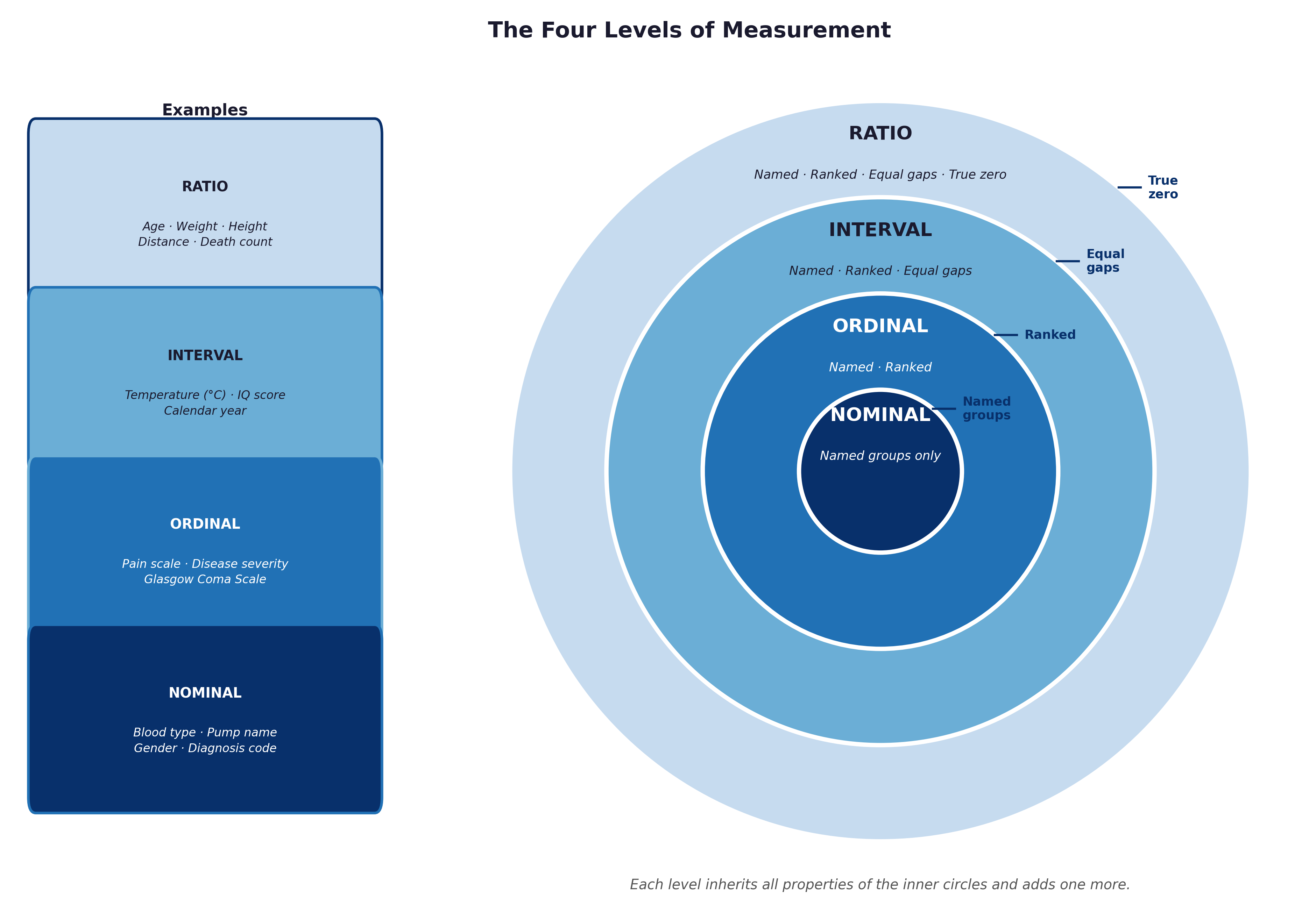
Fig. 2 Figure 1.2 The four levels of measurement as nested layers. Each level inherits all the properties of those below it and adds exactly one new mathematical property.#
The diagnostic shortcut: If you can multiply two values and the result makes clinical sense (“this patient’s BP is twice normal”), the variable is ratio. If only subtraction is meaningful, it is interval. If the numbers are ranks with unequal gaps, it is ordinal. If the values are simply labels, it is nominal.
Section 3: Why Getting This Wrong Causes Real Harm#
Scenario A — Nominal coded as numbers:
EDUC is coded 1, 2, 3, 4. A researcher calculates a mean education of 2.1 and reports “the average participant had between high school and some college education”. This is borderline — ordinal data being treated as interval. The mean assumes equal gaps between levels, which is almost certainly untrue.
Scenario B — Ordinal treated as interval: Cancer stage (I–IV) is entered into a spreadsheet as 1, 2, 3, 4. A mean stage of 2.3 is reported. The survival gap between Stage I and II is not clinically equivalent to the gap between Stage III and IV. The mean is entirely misleading.
Scenario C — Interval treated as ratio: A researcher looks at birth years and states that patients born in 1968 were “twice as recent” as those born in 984 CE. This is mathematical nonsense — calendar year has no true zero, so ratios are completely invalid.
Section 4: Classifying the Datasets#
1. The Anorexia Clinical Trial
Variable |
Description |
Level |
Reasoning |
|---|---|---|---|
|
Therapy group |
Nominal |
Three unordered categories (CBT, FT, Cont) |
|
Baseline weight (lbs) |
Ratio |
0 lbs = no mass; ratio is valid |
|
Follow-up weight (lbs) |
Ratio |
0 lbs = no mass; ratio is valid |
2. The Framingham Heart Study
Variable |
Description |
Level |
Reasoning |
|---|---|---|---|
|
Participant ID number |
Nominal |
A label — ID 1050 is not “more” than ID 1025 |
|
1=Male, 2=Female |
Nominal |
Two unordered categories |
|
Education level 1–4 |
Ordinal |
Ranked, but unequal gaps between levels |
|
Age at exam (years) |
Ratio |
0 = newborn; 60 is twice 30 |
|
Current smoker 0/1 |
Nominal |
Binary category |
|
Cigarettes per day |
Ratio |
0 = does not smoke; 20 is twice 10 |
|
Total cholesterol (mg/dL) |
Ratio |
0 = no cholesterol detectable |
|
Systolic BP (mmHg) |
Ratio |
0 = no measurable pressure |
|
Diastolic BP (mmHg) |
Ratio |
Same as SYSBP |
|
On BP medication 0/1 |
Nominal |
Binary category |
|
Diabetes present 0/1 |
Nominal |
Binary category |
|
Body mass index (kg/m²) |
Ratio |
0 = no body mass |
|
Heart rate (bpm) |
Ratio |
0 bpm = cardiac arrest |
|
Blood glucose (mg/dL) |
Ratio |
0 = no detectable glucose |
|
Prevalent CHD at baseline |
Nominal |
Binary category |
|
Prevalent hypertension |
Nominal |
Binary category |
|
Incident CHD during follow-up |
Nominal |
Binary outcome |
|
Days to CHD event or censoring |
Ratio |
Time is measured on a ratio scale |
|
Death during follow-up |
Nominal |
Binary outcome |
|
Days to death or censoring |
Ratio |
Time is ratio |
|
Incident stroke |
Nominal |
Binary outcome |
|
Days to stroke or censoring |
Ratio |
Time is ratio |
🔬 Lab Manual — Chapter 1#
Objective#
Load the datasets in PSPP and R. Assign the correct variable types and measurement levels. Perform a first inspection of the data structure.
Option A — PSPP (Framingham Data)#
Open PSPP.
Import the CSV file first: Go to File → Import Data. Select
framingham_teaching.csvand click through the wizard to parse the comma-separated data.Click the Variable View tab at the bottom of the screen.
Update the Measure column to correctly classify the data:
Variable |
PSPP Measure |
|---|---|
|
Nominal |
|
Nominal |
|
Ordinal |
|
Scale |
|
Nominal |
|
Scale |
|
Scale |
|
Scale |
|
Scale |
|
Scale |
|
Nominal |
|
Nominal |
|
Nominal |
Note: PSPP uses Scale for both interval and ratio variables. Use Nominal for all 0/1 coded binary variables. Use Ordinal for
EDUC.
Save your configured workspace: File → Save As and name it
framingham_study.sav.
Option B — R / RStudio (Both Datasets)#
# -------------------------------------------------------
# Chapter 1 Lab: Loading the Datasets
# -------------------------------------------------------

# --- PART 1: The Observational Dataset (Framingham) ---
# NOTE: Make sure your working directory is set to the folder containing
# your data, or use Session -> Set Working Directory -> To Source File Location
fram_data <- read.csv("data/framingham_teaching.csv")

# First look
head(fram_data)
nrow(fram_data)   # Should be 500
ncol(fram_data)   # Should be 22

# Check the structure — what types has R automatically assigned?
str(fram_data)

# Summary statistics for all variables
summary(fram_data)

# Convert categorical variables to properly labelled factors
fram_data$SEX <- factor(fram_data$SEX,
  levels = c(1, 2), labels = c("Male", "Female"))

fram_data$EDUC <- factor(fram_data$EDUC,
  levels = c(1, 2, 3, 4),
  labels = c("0-11yrs", "HS_GED", "Some_college", "College_grad"),
  ordered = TRUE)   # ordered=TRUE explicitly marks it as ordinal

fram_data$CURSMOKE <- factor(fram_data$CURSMOKE,
  levels = c(0, 1), labels = c("Non-smoker", "Smoker"))

fram_data$DIABETES <- factor(fram_data$DIABETES,
  levels = c(0, 1), labels = c("No", "Yes"))

fram_data$ANYCHD <- factor(fram_data$ANYCHD,
  levels = c(0, 1), labels = c("No_event", "CHD_event"))

fram_data$DEATH <- factor(fram_data$DEATH,
  levels = c(0, 1), labels = c("Survived", "Died"))

# Note: For a complete analysis, you would apply this same factor()
# process to the other categorical variables like BPMEDS, PREVCHD, and STROKE.

# Verify the changes
str(fram_data)
summary(fram_data$EDUC)     # Should show an ordered factor with 4 levels
summary(fram_data$ANYCHD)   # Should show counts for each outcome (No_event vs CHD_event)

# --- PART 2: The Experimental Dataset (Anorexia) ---
# The anorexia dataset is built directly into the MASS package.
library(MASS)
data(anorexia)

# The 'Treat' variable is already a factor, but let's check the structure
str(anorexia)
summary(anorexia)
What to look for:
After conversion,
str()should showSEX,CURSMOKE,DIABETES,ANYCHD, andDEATHasFactor.EDUCshould show asOrd.factor, an ordered factor.AGE,SYSBP,BMI, andTOTCHOLshould remainintornum(numeric).summary(fram_data$SYSBP)shows min, quartiles, mean, max. What is the median systolic BP in this cohort? Is it above the clinical threshold of 120 mmHg?In the Anorexia data,
Treatshould show as aFactorwith 3 levels, and weights as numeric.
🧪 Test Your Knowledge#
The variable EDUC is stored in the raw CSV as integers 1, 2, 3, 4. A student calculates the mean EDUC and gets 2.1, reporting “the average participant had between high school and some college”.
(a) What level of measurement is EDUC?
(b) Is calculating the mean mathematically valid here?
(c) What would be a more appropriate summary statistic?
Show Solution
# (a) EDUC is ordinal — the levels are ranked (more education = a higher number)
#     but the gaps between levels are not equal in any mathematically meaningful sense.

# (b) Calculating the mean is not strictly valid for ordinal data because
#     the mean assumes equal gaps between categories. The gap from "no qualification"
#     to "GED" may be very different from the gap from "some college" to
#     "college graduate". The mean distorts the summary.

# (c) Appropriate summary: the MEDIAN or MODE.
median(as.numeric(fram_data$EDUC))  # Median education level
table(fram_data$EDUC)               # Frequency count — reveals the modal category
Key Terms#
Term |
Definition |
|---|---|
Observational design |
Studying a population without active intervention to identify risk factors. |
Experimental design |
Actively intervening to test the efficacy of a treatment (e.g., a clinical trial). |
Categorical data |
Data placing observations into named groups; arithmetic is not meaningful. |
Continuous data |
Data measured on a numerical scale; arithmetic operations produce valid results. |
Nominal |
Categories with absolutely no natural order. Examples: |
Ordinal |
Ranked categories with unequal gaps. Example: |
Interval |
A numerical scale with equal gaps but no true zero. Example: calendar year. |
Ratio |
A numerical scale with equal gaps and a true zero. Examples: |
Level of measurement |
The classification of a variable that determines which mathematical operations are legitimate. |
True zero |
A zero value representing the complete absence of the measured quantity. |
Review Questions#
Explain the primary difference between observational epidemiology (like the Framingham Study) and experimental epidemiology (like the Anorexia trial).
Classify each of the following Framingham variables at the correct level of measurement and justify your answer:
HEARTRTE,GLUCOSE,BPMEDS,CIGPDAY,EDUC.ANYCHDis stored as 0 and 1. A student calculates the mean ANYCHD across all 500 participants and gets 0.31. (a) What does this number actually mean? (b) Is calculating the mean of a 0/1 variable mathematically meaningful? (c) What is the correct level of measurement forANYCHD?A hospital records each patient’s diastolic blood pressure in mmHg. Classify this variable at the correct level and justify every step.
Explain why
EDUC(education level 1–4) is ordinal rather than interval. Give a specific example of an interval statement that would be invalid for this variable.In R, after loading the dataset, run
str(fram_data). Which variables does R initially classify asintthat should actually be treated as nominal or ordinal factors? Write the code to correct each one.A researcher averages the
EDUCscores across all participants and reports “mean education = 2.1”. Another researcher reports “the modal education level is ‘0–11 years’ (Level 1), seen in 193/500 participants”. Which summary is more clinically appropriate and why?
Key Takeaways
Study Design: Observational watches for risks; Experimental actively tests interventions.
Two data families: Categorical (named groups) vs. Continuous (measurable quantities).
Four levels: Nominal \(\rightarrow\) Ordinal \(\rightarrow\) Interval \(\rightarrow\) Ratio. Each level adds exactly one property.
Framingham dataset:
SEX,CURSMOKE,DIABETES,ANYCHD,DEATH= nominal;EDUC= ordinal;AGE,SYSBP,BMI,TOTCHOL= ratio.Common error: Numeric storage \(\neq\) numeric meaning. Always convert categorical variables to factors in R.
Ratio vs interval: Ask — does zero mean complete absence? BP 0 = cardiac arrest (ratio). Year 0 = arbitrary reference (interval).
Next: Chapter 2 — The Middle and the Mess uses the ratio variables to calculate the descriptive statistics that characterise our datasets.
Part I — Describing the World in Numbers